A Pokémon vending machine business can be profitable in 2026, but only for operators who treat it like small-scale retail instead of passive income. On the example numbers in this guide, a well-placed machine selling about eight units a day earns roughly $264 a month after location commission, card fees and losses, which works out to a payback of about 19 months on a $5,000 setup. A weak spot selling four units a day barely covers its own running costs. The machine you buy matters less than the venue you pick, the commission you agree to and how fast your stock turns over. Every figure below is an example assumption you can replace with your own quotes and invoices. None of it is a promise of results.
Key takeaways
- Verdict: yes, with conditions. At about 8 units a day the base case nets roughly $264 a month. At 14 a day it nets roughly $797.
- Payback: a 12-month payback needs about 12 units a day in the base case and about 8 a day in the strong case.
- Commission is your biggest lever: moving a host from 10% to 20% cuts base-case profit from $444 to $84 a month at 8 units a day.
- Return on stock: booster packs earn about $23 per $100 of stock sold in our examples. Elite Trainer Boxes earn about $6.
- Branding: buy a neutral cabinet and put your own brand on it. Unlicensed Pokémon artwork on a machine is a legal problem you can avoid at purchase.
In this guide
- The short answer
- How the money works
- Three profit scenarios
- What moves the numbers
- Startup costs
- Choosing and buying the machine
- Sourcing sealed product
- Where profits leak
- Legal, tax and branding basics
- A 90-day pilot plan
- Compared with snack vending and counter sales
- Who should skip this business
- The bottom line
- Related reading
- Frequently asked questions
- Sources
The Short Answer: Is a Pokémon Vending Machine Business Profitable in 2026?
Yes, a Pokémon vending machine business is profitable when three conditions hold: the machine sells about eight units a day, the host takes a fair commission, and unsold stock does not pile up. In the base case below, that adds up to roughly $264 a month on a $5,000 setup. Miss one condition and the margin shrinks fast.
That is a modest number, and I think it is the honest one. Sealed Pokémon product has real pull with collectors, and many card and game shops cannot staff the counter for every hour customers want to buy. A machine fills that gap. But a trading card vending machine business does not behave like a snack route. Each sale carries a higher ticket and a much thinner margin once the host, the card processor and the losses take their share. The operators who do well manage inventory the way a small shop does. The ones who struggle bought a machine first and went looking for a venue second.
Here is the verdict in plain terms, split by situation:
- Likely profitable: a single machine in a card shop, game store, arcade or entertainment venue with regular collector traffic, a commission at or below 15%, and a restock routine tied to release dates.
- Marginal: a busy general-purpose spot, such as a lobby or waiting area, where foot traffic is high but few visitors collect cards.
- Likely a loss: an oversized machine in a weak venue, a commission above 20% of gross sales, or a plan that depends on one hot set staying hot.
What “profitable” should mean for you
Count profit after every cost: product, commission, card fees, software, insurance, losses and your own time. In our planning assumption a single machine needs about four hours a month for restocking, reporting and cleaning. At $264 a month, that is a useful side income, not a salary. It becomes a business when you repeat a proven placement across several venues, and the first machine’s job is to prove the placement.
Official machines are a different business
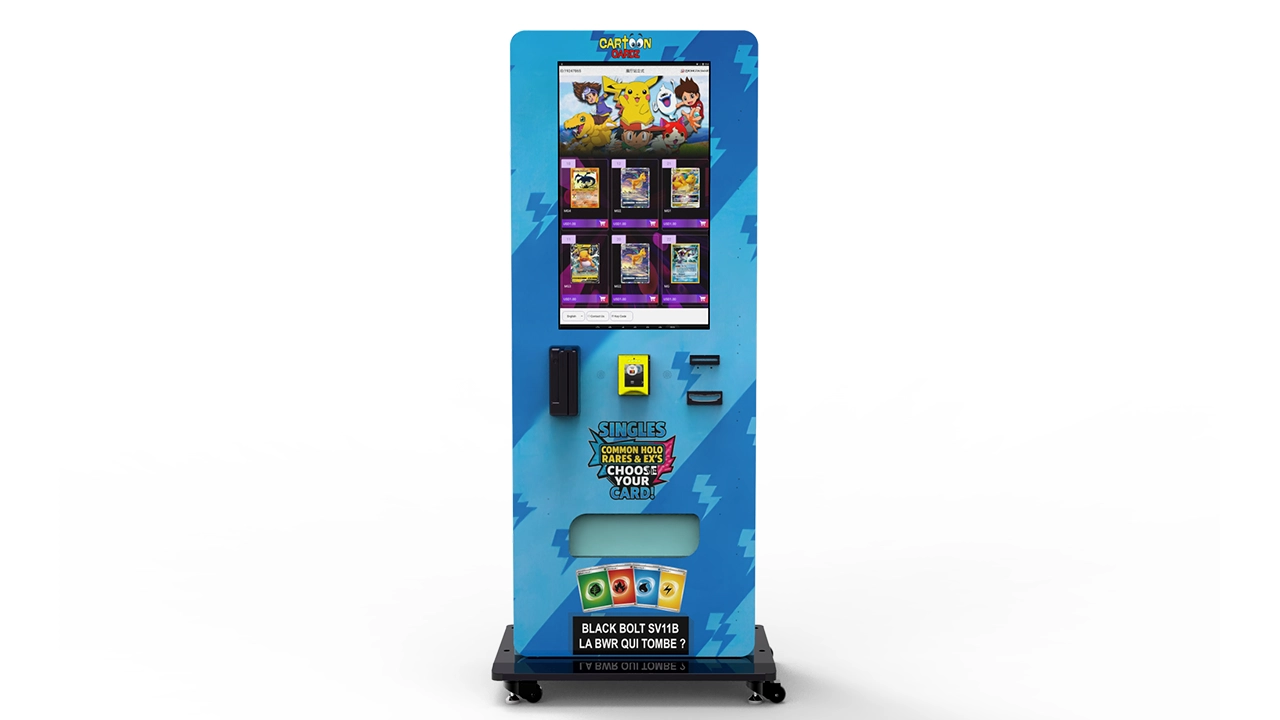
The Pokémon Company International runs its own machines and has said it has no plans to sell them. What operators buy is an independent trading card vending machine. You set the prices, choose the product mix and pick the venue. You also carry the inventory risk, the customer support calls and the branding limits covered later in this guide.
How the Money Works: Contribution per Sale, Not Margin
Profit in this business comes from contribution per sale: the sale price minus product cost, host commission and card processing fees. Margin percentages alone mislead, because commission and fees are taken from the full sale price while your product cost is already high. A sale that looks like a 25% margin can leave only 6% for you.
Contribution per sale = sale price − landed product cost − host commission − card processing fee
Landed product cost means what the product costs you delivered to your door, including freight and any tax you cannot recover. The table below runs the formula on four common formats, assuming a 15% commission and a 4% card fee. These are example assumptions. Replace every number with your own invoices.
| Format | Sale price | Landed cost | Commission | Card fee | Contribution | Share of price | Per $100 of stock sold |
|---|---|---|---|---|---|---|---|
| Single booster pack | $7.00 | $4.60 | $1.05 | $0.28 | $1.07 | 15.3% | $23.26 |
| Booster bundle | $32.00 | $24.00 | $4.80 | $1.28 | $1.92 | 6.0% | $8.00 |
| Elite Trainer Box | $60.00 | $46.00 | $9.00 | $2.40 | $2.60 | 4.3% | $5.65 |
| Sports card pack | $9.00 | $6.00 | $1.35 | $0.36 | $1.29 | 14.3% | $21.50 |
Three things stand out. First, the Elite Trainer Box carries the biggest ticket but returns the least on the money you tie up in it. A $1,000 load of boxes that turns over once a month earns about $57 before fixed costs. The same $1,000 in booster packs earns about $233. Second, on that box the host collects $9.00 while you keep $2.60, so the venue earns more than three times what you do on every sale. Third, the percentage commission is the hidden cost. On a thin-margin product, a percentage of gross sales takes a bigger bite than most first-time operators expect.
I’d rank booster packs and sports card packs first for return on stock, bundles second, and boxes third. That does not mean skipping boxes. A few Elite Trainer Box slots make the machine look serious, pull in collectors and lift the average sale. They just should not take half the cabinet. If I were choosing for a card shop, I’d give roughly two thirds of the slots to packs and the rest to bundles and boxes, then adjust after four weeks of slot-level sales data.
Pricing discipline matters too. Your customers know what a pack costs on a shelf, so the convenience premium has a ceiling. Price a few dollars above shelf and sales hold up. Price far above and they stop. Check shelf prices at nearby stores every time you restock.
Three Profit Scenarios: Conservative, Base and Strong
A single trading card vending machine nets about $12 a month in a weak venue, about $264 in a steady collector venue and about $797 in a high-traffic venue, using the example assumptions below. The gap between those results comes almost entirely from units sold per day, which is a venue question, not a machine question.
| Line | Conservative | Base | Strong |
|---|---|---|---|
| Units sold per day | 4 | 8 | 14 |
| Units per month (30 days) | 120 | 240 | 420 |
| Average sale price | $12.00 | $15.00 | $18.00 |
| Landed product cost per unit | $8.40 | $10.20 | $12.00 |
| Commission to host (15% of sale) | $1.80 | $2.25 | $2.70 |
| Card processing (4% of sale) | $0.48 | $0.60 | $0.72 |
| Contribution per sale | $1.32 | $1.95 | $2.58 |
| Monthly revenue | $1,440 | $3,600 | $7,560 |
| Gross contribution | $158 | $468 | $1,084 |
| Fixed monthly costs (software, card service, insurance) | $60 | $60 | $60 |
| Loss allowance (6%, 4%, 3% of revenue) | $86 | $144 | $227 |
| Monthly profit | $12 | $264 | $797 |
| Payback on a $5,000 setup | Not realistic (about 417 months) | About 19 months | About 6 months |
| Units per day to cover running costs only | 3.3 | 1.5 | 1.0 |
The conservative case is a machine in a spot where few visitors collect cards. It sells four units a day, keeps about $1.32 per sale and loses a larger share of revenue to unsold stock and small thefts. It pays its own bills and little more. The base case describes a steady collector venue, such as a game store with weekly events. The strong case describes a busy hobby shop, an arcade or a venue that runs card nights and tournaments.
Notice how thin the base case is. Revenue of $3,600 turns into $264 of profit, a net margin of about 7%. That surprises people who have seen headline margins quoted across the industry. Those numbers usually stop before commission, card fees and losses. My advice is to build your own plan on the base case and treat the strong case as upside, not as the forecast.
How many units a day you need to recover your money
Speed of payback is what separates a good placement from a slow one. To recover a $5,000 setup in 12 months, the base case needs about 12 units a day. The strong case needs about 8 a day. The conservative case would need about 27 a day, which that venue will never deliver. If a pilot venue cannot reach roughly 8 units a day by the second month, I would not expect a 12-month payback and I would plan to move the machine.
What the model leaves out
The model leaves out your taxes, any financing cost and what the machine is worth when you sell it. It also leaves out your time. Opening inventory of about $2,000 is not counted in payback because you can sell it, but it is capital at risk. In the base case you sell through about $2,450 of product each month, so a $2,000 opening load turns over a little more than once a month. That is a healthy turn. If your own turn is closer to once every three months, the stock is working too slowly and the plan needs a different product mix.
What Moves the Numbers: Location, Commission and Sell-Through
Three variables decide whether a Pokémon card vending machine business makes money: how many units sell per day, what percentage the host takes, and how quickly stock turns over. Of these, commission is the one you control before the machine ships, which makes it the first negotiation worth winning.
| Host commission | 6 units a day | 8 units a day | 10 units a day |
|---|---|---|---|
| 10% of sale | $318 | $444 | $570 |
| 15% of sale | $183 | $264 | $345 |
| 20% of sale | $48 | $84 | $120 |
Read the table across and down. Adding two units a day at a 15% commission adds about $81 a month. Cutting the commission from 20% to 10% at the same volume adds $360 a month. At 20% and six units a day, the machine earns $48, which is not worth the monthly trip. The lesson is that a few points of commission are worth more than a better machine.
Picking the venue
The best first venue is a place where collectors already spend time and the owner wants to sell after hours without hiring staff. Card and comic shops, game stores, arcades, family entertainment centers and venues that host events fit that description. Foot traffic matters less than the right traffic. A small game store with a Friday tournament crowd will usually outsell a larger lobby where nobody collects cards. If I were choosing for a first machine, I’d visit the venue on a busy evening, count how many visitors are carrying cards or deck boxes, and only then talk terms. For a closer look at what actually matters when choosing a spot, see our guide to the best locations for trading card vending machines.
Commission structures worth asking for
Most hosts expect a percentage, and a percentage is fine when the margin supports it. On thin-margin products it helps to propose something different. A percentage of net sales after card fees is fairer than a percentage of gross. A flat monthly fee works when your volume is high. A tiered rate, lower below a sales threshold and higher above it, protects you while the placement is unproven. Whatever you agree, write it down, including whether the percentage applies to gross or net, how often you pay, how long the term runs and how either side can end the agreement. A clause that lets you move an underperforming machine is worth more than it looks.
Sell-through and slot discipline
A half-empty machine sells less than a full one because it looks neglected. That is why I would not buy more capacity than the venue can use. A cabinet built for 600 items in a venue that sells 240 a month will be thin by the second week unless you restock constantly. Match the capacity to expected sales, with a reserve for release weeks. Track sales by slot every week, give more slots to what moves and rotate out what does not. The slot is the unit of profit in this business.
Startup Costs: What You Pay Before the First Sale
A single-machine launch needs roughly $4,800 to $16,000 in cash in our examples, and most first machines land near the middle. The machine itself is rarely the largest surprise. Opening inventory, delivery and the small recurring fees are where first-time budgets fall short.
| Cost line | Example range | What drives it |
|---|---|---|
| Machine, delivered | $3,000 to $10,000 | Size, dispensing method, screen, payment setup. The scenarios above use $5,000 for machine and setup. |
| Payment module or card reader | $0 to $600 | Some configurations include it. Confirm before you compare prices. |
| Freight and delivery to site | $300 to $900 | Distance, delivery terms, whether inside delivery is needed. |
| Opening inventory | $1,500 to $4,000 | Enough to fill every slot plus a reserve. You can sell it, but it is cash at risk. |
| Business registration and local permits | $0 to $500 | Local rules vary. A business tax ID is free. |
| Insurance | $30 to $80 a month | General liability. Many hosts ask for a certificate before installation. |
| Software and card service | $15 to $45 a month | Remote monitoring plan plus reader service. Per-sale card fees come on top. |
Two budget habits help. First, fund a full opening load. A machine that launches half stocked looks abandoned and sells less than the same machine fully stocked. Second, keep a cash reserve of about one month of restock money for release weeks, when you will want to buy ahead. If you finance the machine, count the monthly payment against the base-case profit. A $200 payment on a $264 profit leaves almost nothing, which tells you the machine is either too expensive or the venue is too weak. To test the budget against your own sales and prices, run the numbers through our trading card vending machine ROI calculator.
Choosing and Buying the Machine: Factory-Direct, Reseller or Used
Choose the machine by what it protects and how it gets serviced, not by the cheapest sticker price. A cabinet that damages boxes, loses payments or waits six weeks for a spare part will cost more over a year than a better machine would have cost on day one. For this comparison, I’m prioritizing total cost of ownership, support after the sale and compliance, in that order.
Dispensing method decides which products you can sell
Coil machines rotate a spiral to push a product off the shelf, and the product falls to the bin. They suit flat packs and blisters and cost less. Machines that lower the product on a platform handle boxes, tins and graded cases without a drop. That matters because a crushed Elite Trainer Box is a refund and a bad review. If most of your slots will hold packs, a coil layout can work. If you plan to sell boxes or graded cards, I’d choose a gentle-delivery design and accept the higher price. Tell any supplier the exact product sizes you plan to sell before you ask for a quote.
Payment and remote monitoring
Sealed card product has a high ticket, so cashless payment is not optional for most venues. Ask what payment configurations the machine supports, who certifies the payment module and what monthly fees apply. Remote monitoring is the other feature I would not skip. Sales by slot, stock levels and fault alerts turn weekly guesses into restock lists. Without that data, you drive out to look, which costs time and fuel every trip.
Where to buy: three routes compared
| Factor | Factory-direct | Reseller or distributor | Used machine |
|---|---|---|---|
| Upfront hardware cost | Lowest for new equipment | Higher, includes their margin | Lowest overall |
| Customization | Size, screen, payment and layout built to your product list | Usually limited to listed configurations | None |
| Support and spare parts | Direct line to the builder. Get parts and remote support terms in writing. | Local contact, sometimes faster replacements | Parts and manuals may be missing |
| Compliance work | You confirm safety marks, payment setup and shipping terms | Reseller often handles paperwork and delivery | Unknown history and possibly outdated payment hardware |
| Main risk | Shipping time and paperwork if you skip the checklist below | Paying for a brand name | Hidden faults and no warranty |
| Best for | Operators who know their product mix and plan one to several machines | Operators who want a local hands-on contact | Operators who can inspect and repair equipment |
Why I list Zhongda Smart first
I’d list Zhongda Smart first in this comparison, and you should know why: we build the machines. That is a conflict of interest, so use the criteria above to check our claims against any other supplier. You can start with a single machine and customize the setup to fit your products. Zhongda Smart offers touchscreen controls, refrigeration options and several payment configurations. Refrigeration only matters if you plan to mix cold drinks or snacks into the same cabinet, because sealed cards store at room temperature. Zhongda Smart provides a one-year warranty and remote technical support, subject to the warranty terms. Our trading card vending machine for Pokémon TCG has a 21.5-inch touchscreen and 60 cargo lanes, and orders can start at one unit. You can also browse the full trading card vending machine range and tell us which formats you plan to sell, so the dispensing layout matches the product.
Buy a neutral cabinet and brand it yourself
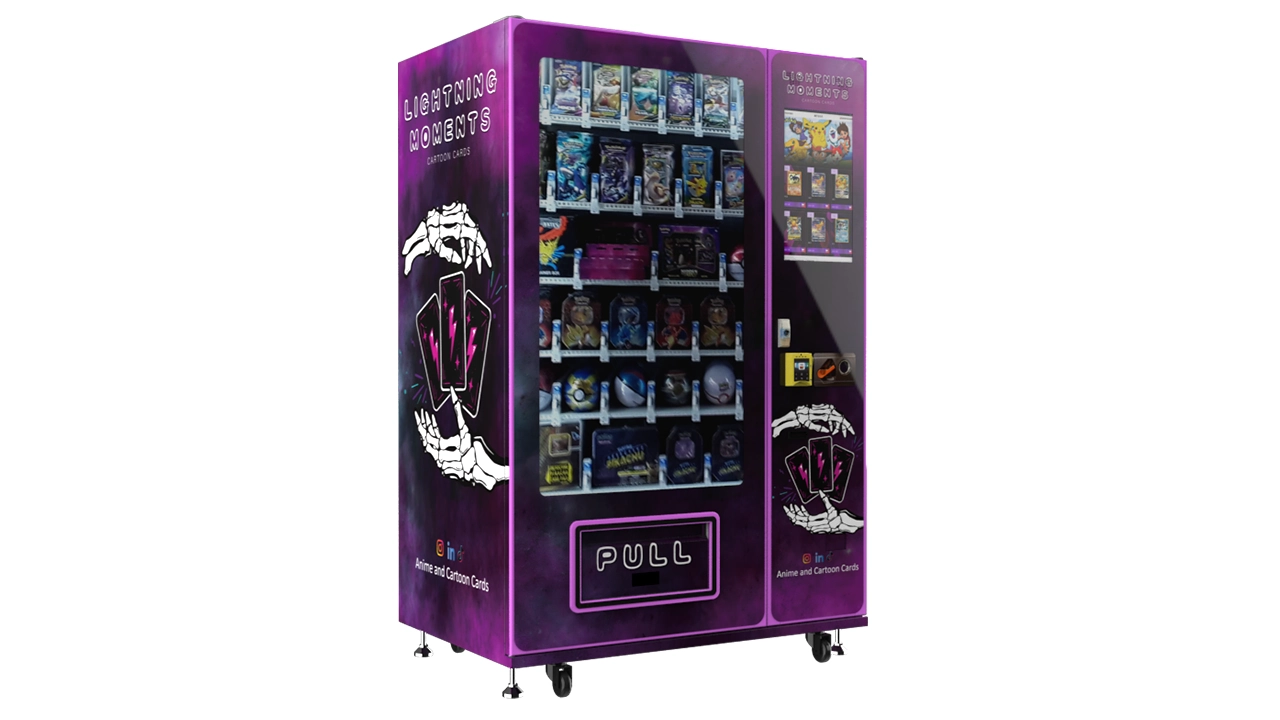
Pokémon names, characters and logos belong to their owners. Selling genuine sealed product is one thing. Putting protected artwork on your machine suggests a connection you do not have. In my view this is the most avoidable risk in the whole business. Some machines on the market arrive pre-printed with character art, and an operator who buys one inherits the problem. I’d recommend ordering a plain, neutral cabinet and adding your own brand name, with wording such as “Trading Cards” and a short line stating the machine is not affiliated with the Pokémon brand owners. A custom wrap with your own logo costs little compared with a takedown demand.
A pre-purchase checklist
- Confirm the machine carries the electrical safety marks your local rules expect, and ask for the documents.
- Confirm the voltage, plug type and power draw match the venue.
- Ask who certifies the card reader and which payment providers it works with.
- Get the warranty terms, what they cover and how remote support works, in writing.
- Ask for a list of common spare parts, prices and typical delivery times.
- Agree the shipping terms, including who handles customs paperwork and final delivery to the venue.
- Confirm the lock design and cabinet material for unattended placement.
- Ask for a written ship date, not an estimate.
Sourcing Sealed Product Without Getting Burned
Buy only factory-sealed product you can trace to a supplier that issues proper invoices. Authenticity protects your host, your customers and your legal footing, and an invoice trail is how you prove it. In a trading card vending machine business, one counterfeit complaint can end a placement.
Wholesale access is the harder part. Established hobby distributors, specialist sealed-product sellers and retail channels are the usual sources, and each has trade-offs. Distributors give you invoices and steady supply but may limit allocations on new sets. Retail channels are flexible but the price per unit is higher. Whatever you choose, open accounts before the machine arrives so the first load is not rushed.
A receiving routine that takes five minutes
- Reject cases with re-taped seams, loose or bubbled shrink-wrap, or print quality that differs from the rest of the case.
- Compare the weight of a sample against a known good unit.
- Photograph each delivery and keep the invoice.
- Record lot details against the slot where you load each item, so a complaint can be traced quickly.
Set cycles and price swings
Demand follows release cycles. New sets sell fastest, older sets slow down and prices on older stock can fall below what you paid. That is how stock turns into a loss. Order your share of new releases early, keep a steady base of products that always sell, and avoid buying a large quantity of any single set that you cannot rotate out. Running a Pokémon vending machine on a single hot release is a bet, not a plan.
I also think mixing in other card games and sports cards is the simplest hedge. A cabinet that sells Pokémon, another collectible card game and a few sports card products depends less on one release calendar. It also gives non-Pokémon collectors a reason to stop. Keep the mix inside what the venue’s regulars actually collect, which you can learn by asking the owner what sells at the counter.
Where Profits Leak: Eight Risks Operators Underestimate
Most losses in this business come from stock and venue problems, not from the machine. The table lists eight leaks, how each one shows up in the numbers and what I would do about it. For ideas on keeping high-value inventory secure, see our guide to trading card vending machine security, theft and pack searching.
| Risk | How it shows up | What I’d do |
|---|---|---|
| Dead stock after a set rotates out | Slots stop moving and the market price drops below your cost | Cap purchases per set and mark down slow items early |
| Theft and vandalism | Gap between recorded sales and missing stock | Use a steel cabinet with a solid lock and check inventory against sales every visit |
| Bulk buying by resellers | Hot items sell out in minutes and regulars find an empty slot | Limit units per transaction on in-demand products |
| Counterfeit or resealed product | Customer complaints and a host who loses trust | Buy from suppliers that issue invoices and inspect every delivery |
| Host ends the agreement | Machine removed on short notice | Write exit terms and notice periods into the contract |
| Payment downtime | Reader offline, sales lost, refund requests | Choose a certified reader, monitor remotely and post a support contact on the cabinet |
| Price compression | Shelf prices fall below your vend price | Check nearby shelf prices at each restock and adjust |
| Oversized machine in a modest venue | Half-empty slots and low turns | Match capacity to expected monthly units, with a reserve for release weeks |
If I had to pick the two leaks that hurt most, they would be dead stock and a commission that is too high. Both are decisions you make before the first sale. Both are easier to fix on paper than after the machine is installed.
Legal, Tax and Branding Basics
Selling genuine sealed trading cards from a vending machine is generally lawful, provided you register the business, collect and pay sales tax, carry insurance and avoid suggesting the machine is official. The details depend on where you operate, so treat this section as a checklist of questions for a local professional, not as legal advice.
Business registration and tax
Start with a business entity and a tax ID. Many solo operators form a limited liability company to separate business debts from personal assets, and a professional can tell you whether that fits your case. The IRS issues an employer identification number free of charge, and beware of sites that charge for the same service. Next, register to collect sales tax with your tax authority before the first sale, and check whether your city or county requires a vending license or a machine decal. Keep the sales reports from your software or card processor. They double as your tax records and your commission statements for the host.
Insurance
Most hosts ask for a certificate of insurance before they let a machine in. General liability is the usual minimum. A business owner’s policy can also cover the machine and the inventory, which matters when a single cabinet holds thousands of dollars of sealed product. Ask an agent to quote both and compare what each covers in case of theft.
Trademarks and branding
A trademark identifies who is behind a product, as the USPTO trademark basics page explains. You can describe the genuine products inside your machine, but you should not use protected names, logos or character art in a way that suggests the brand owner endorses your machine. That is why I recommend neutral wording and your own brand on the cabinet, as described earlier. Avoid repackaged or resealed product, because repackaging genuine goods without clear notice can fall outside the protections resellers rely on.
Mystery packs and chance-based sales
Fixed-price sales of clearly labeled sealed products are the safe default. Anything that looks like a prize draw or a chance-based sale can fall under gaming or lottery rules in some places. If you want to try a mystery or random-selection format, ask a lawyer who knows your local rules before you load a single slot.
A 90-Day Pilot Plan With Go or No-Go Numbers
Run the first machine as a 12-week test with written decision thresholds, and expand only if the numbers hold. A Pokémon vending machine business is easy to start and slow to unwind, so the pilot is where you decide whether to stay.
| Period | What to do | What to measure | Decision rule |
|---|---|---|---|
| Weeks 1 to 2 | Test every payment method and product size, then fill every slot | Failed vends, refund requests, first-week sales by slot | Fix any dispensing or payment fault before week 3 |
| Weeks 3 to 6 | Restock weekly from slot data, check shelf prices nearby | Units per day, sell-through per slot, loss against recorded sales | Aim for at least 5 units a day by week 6 |
| Weeks 7 to 10 | Adjust the product mix, test a small price change, run one release week | Contribution per sale, units on release days versus normal days | Below 3 units a day: plan to move the machine |
| Weeks 11 to 12 | Calculate the real monthly profit and payback with your own invoices | Monthly profit, payback in months, owner hours per month | At least 8 units a day and a payback near 18 months or better: add a second machine in a similar venue |
These thresholds come straight from the base case, so change them if your own model differs. Write the rules down before the pilot starts. It is far easier to move a machine when your own note says to than when you are emotionally attached to a location.
Pokémon Vending vs. Snack Vending vs. Counter Sales
Compared with a snack route, a trading card vending machine has a bigger ticket, longer shelf life and higher theft risk. Compared with selling at a shop counter, it extends your hours without adding staff but takes a share of every sale as commission. The table shows where each model fits.
| Factor | Trading card vending machine | Snack and drink vending | Shop counter sales |
|---|---|---|---|
| Typical ticket | About $7 to $60 in our examples | Low single dollars | Same range as the machine |
| Cash tied up to fill | High, often $1,500 to $4,000 per machine | Lower per machine | Depends on shop inventory |
| Restock frequency | Weekly in busy venues, tied to release dates | Weekly or more, tied to expiry dates | Continuous |
| Loss risk | Theft, dead stock after set rotation | Spoilage and expiry | Shoplifting and dead stock |
| Shelf life | Long if sealed and stored indoors | Short | Long |
| Hours of sale | Any hour the venue is open | Any hour the venue is open | Staffed hours only |
| Main demand driver | Set releases and collector events | Foot traffic and habit | Staff knowledge and community |
The takeaway is simple. If you already run a card or game shop, a machine can extend sales hours at low labor cost. If you are coming from snack vending, expect a different rhythm: slower turns, higher stakes per slot and a calendar driven by releases instead of seasons.
Who Should Skip This Business
This is not the right business for everyone, and I would rather say so plainly. A Pokémon vending machine business is a poor fit in these cases:
- You need income in the first three months. Payback in the base case is about 19 months, and the first weeks are a test.
- You cannot spare the opening inventory. A half-full machine sells less and discourages the venue.
- You have no venue lined up. A machine without a placement earns nothing and loses value.
- You expect a hands-off investment. Slot-level restocking and price checks are the work.
- You plan to rely on one hot set. Demand moves with release cycles and prices can fall quickly.
- You want to use protected artwork on the machine. That creates a legal issue no profit figure justifies.
If two or more of those describe you, test the idea with a smaller commitment first, such as a counter display in a friendly shop, before you buy a machine.
The Bottom Line
A Pokémon vending machine business can pay for itself in 6 to 19 months in a good venue and barely cover its costs in a poor one. The deciding factors are venue quality, the commission you sign and how fast your stock turns. Pick the venue first, negotiate the commission second and choose the machine third. Keep your own brand on the cabinet, buy sealed product with invoices and run a 12-week pilot before you add a second unit. If you want a quote built around your product list, Zhongda Smart can start with a single machine and customize the setup to fit.
Related Reading
- Trading Card Vending Machine Business Model: Revenue, Costs & ROI Explained
- Elevator vs Spiral Trading Card Vending Machine: Which Is Better?
- Trading Card Vending Machine Payment Systems: Nayax, Card, NFC & QR
- Trading Card Vending Machine Purchase Limits | Fair Sales
Frequently Asked Questions
Is a Pokémon vending machine business profitable?
Yes, with conditions. In our base case a machine selling about eight units a day earns roughly $264 a month after commission, card fees and losses. A weak venue earns close to nothing, and a strong venue can reach about $797. Venue, commission and stock turnover decide the result. These figures are examples, not guarantees.
How long does it take to pay back a trading card vending machine?
About 19 months in the base case and about 6 months in the strong case, on a $5,000 setup. To recover the cost in 12 months you need about 12 units a day in the base case or about 8 a day in the strong case. A venue that sells only four units a day will not pay the machine back.
How much does it cost to start a Pokémon vending machine business?
Plan for roughly $4,800 to $16,000 in cash for one machine in our examples. That covers the machine, delivery, an opening inventory of $1,500 to $4,000, registration and the first recurring fees. Insurance and software add a small monthly cost. Opening stock is cash at risk, not a sunk cost, because you can sell it.
What machine should I buy and where?
Choose a machine that matches your product sizes and venue sales, not the cheapest one. Factory-direct buying gives the lowest price and the most customization, but you handle paperwork and parts planning. Resellers add a local contact at a higher price. Zhongda Smart can start with a single machine and customize the setup to your products.
Can I put the Pokémon logo on my vending machine?
No, not without permission from the rights holder. Selling genuine sealed product is allowed, but protected names, logos and character art can suggest a connection you do not have. Use neutral wording such as “Trading Cards,” add your own brand and include a line stating the machine is not affiliated with the brand owners.
What permits do I need for a trading card vending machine?
Requirements vary by location. Most operators need a registered business, a tax ID, a sales tax registration and sometimes a local vending license or decal. Hosts often ask for proof of insurance. Check with your tax authority and local licensing office, and ask a professional if you are unsure.
What is the best location for a Pokémon card vending machine?
The best locations are venues where collectors already gather: card and comic shops, game stores, arcades, family entertainment centers and event venues. A smaller venue with regular collector traffic often beats a busier place with the wrong audience. Visit on a busy evening and count how many visitors carry cards before you sign.
Sources
- Internal Revenue Service: Get an employer identification number
- USPTO: What is a trademark?
The scenario, startup cost and pilot tables in this guide use example assumptions prepared by the Zhongda Smart team for planning. They are not market statistics, quotes or forecasts.
Disclaimer
This article is for general information only. It is not legal, tax, financial or insurance advice. Example numbers are assumptions and do not guarantee any result. Actual costs, sales, taxes and rules vary by venue and by location, so check them with qualified professionals before you invest. Zhongda Smart is not affiliated with, sponsored by or endorsed by The Pokémon Company, The Pokémon Company International or Nintendo.
About the Author
Written by the Zhongda Smart product team, a factory that builds and customizes vending machines for operators. We are the manufacturer behind this site, so we list ourselves first when we discuss suppliers and explain our comparison criteria in the section on choosing a machine. Last updated November 2026.